

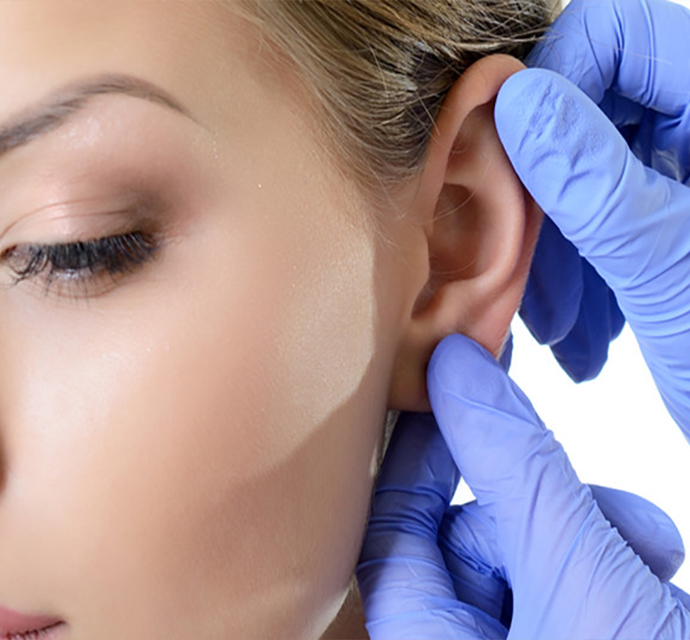
There are deformities in the ear that require ear aesthetic surgery. In prominent ears, the problem is that the angle of your ear with your head is more than normal. In other words, they appear more forward and open than normal. This can lead to significant psychosocial, behavioral and emotional problems, especially in children. In prominent ear aesthetics, only the outer part of the ear is intervened. Prominent ear surgery is an operation that can be performed extremely safely. For this reason, it will not cause any problems with hearing. Since ear development in people is completed by the age of 5-6, it is recommended to perform prominent ear surgery at this age to correct the ear. Prominent ear surgery (otoplasty) is performed under general anesthesia in children. At older ages, it can also be performed without general anesthesia, only with local anesthesia, that is, by numbing the ear. Since prominent ear surgery is performed from the back of the ear, there will be no scar.
For which age is prominent ear surgery more suitable?
Prominent ear surgery is a procedure suitable for all ages. However, the appropriate age for this surgery is preschool age. Children who go to school with prominent ears will face the negative thoughts of their friends and this will affect the mental state of the child. For this reason, before prominent ear surgery, this situation should be explained to the child in a way that he/she will understand and surgery should be performed at his/her own request. This surgery will be performed if the child wants it.
What should I pay attention to before prominent ear surgery?
As in all surgeries, it is necessary to stop using aspirin and stop smoking 2-3 weeks before the surgery in prominent ear surgery. In the last week before the surgery, blood thinning medications and similar substances should not be used.
Will there be a scar on my ear after prominent ear surgery?
It is quite normal to see a thin white line behind the ear after the surgery. Since this thin scar will remain behind the ear, it will not be visible from the outside. Since self-melting stitches are used in the surgery, there is no need to remove stitches after the operation and there will be no stitch scar.
Will I feel pain during prominent ear surgery?
If prominent ear surgery is performed under general anesthesia, you will not feel pain. If it is performed with local anesthesia, only the pain of anesthesia needles will be felt. You will not feel pain during the surgery. After the surgery, you will not feel pain for about 12 hours due to the anesthesia. After this stage, you will not have any serious pain.
What will I experience after prominent ear surgery? Is it necessary to wear a headband?
After the prominent ear operation, an elastic bandage is wrapped around the person. Patients are then sent home. Two days after the operation, the bandages are opened, the wounds are examined and the patient is fitted with a headband to cover the ears. The purpose of the bandage is to protect the patient. Two days after the operation, patients can take a bath easily. The band should be used regularly for a week. The day after the prominent ear surgery, the patient can easily return to work. In the first three weeks after the surgery, the patient should be careful to protect his/her ears from impacts.
Otoplasty — also known as cosmetic ear surgery — is a procedure to change the shape, position or size of the ears.
You might choose to have otoplasty if you’re bothered by how far your ears stick out from your head. You might also consider otoplasty if your ear or ears are misshapen due to an injury or birth defect.
Otoplasty can be done at any age after the ears have reached their full size — usually after age 5 — through adulthood.
If a child is born with prominent ears and certain other ear-shape problems, splinting may successfully correct these issues if started immediately after birth.
Otoplasty is typically done on both ears to optimize symmetry and it won’t change the location of your ears or alter your ability to hear.
How is Otoplasty done?
Otoplasty techniques vary based on what kind of correction is needed. The specific technique your plastic surgeon chooses will determine the location of the incisions and the resulting scars.
Your doctor might make incisions either on the back of your ears or within the inner creases of your ears.
After making incisions, your doctor might remove excess cartilage and skin.
The surgeon then will fold the cartilage into the proper position and secure it with internal stitches. Additional stitches will be used to close the incisions.
Otoplasty recovery
After otoplasty, your ears will be covered in bandages for protection and support.
You’ll likely feel some discomfort and itching. Take pain medication as recommended by your doctor. If you take pain medication and your discomfort increases, contact your doctor immediately.
To keep pressure off your ears, avoid sleeping on your side. Also, try not to rub or place excessive force on the incisions. Consider wearing button-down shirts or shirts with loose-fitting collars.
A few days after otoplasty, your doctor will remove your bandages. Your ears will likely be swollen and red. You may need to wear a loose headband that covers your ears at night for a few weeks. This will help keep you from pulling your ears forward when rolling over in bed.
After your bandages are removed, you’ll notice an immediate change in the appearance of your ears. These changes are permanent.
Fat injection to the face, medically known as adipose tissue transfer, as popularly known as fat fillers, is a surgical application to eliminate the volume loss of the face. During the aging process, our face loses volume.
The fat-filling process is applied to slow down the loss of volume, maintain facial volume, and increase the volume in some special cases. In the face fat filling process, the adipose tissue used as filling is obtained from the person’s own body.
Fat injection to the face can be applied to almost any part of the face. Filling can be done with our own fat to fill mid-forehead collapse, eyebrow volume loss, temple area collapses, under-eye volume deficiencies, chin area volume deficiencies, cheek volume depletion, nasal ridge irregularities.
How to Apply Fat Injections to the Face?
Fat fillers can be applied as small maintenance sessions or as large replacement sessions. Mini-sessions limited to a single area of the face can be performed under local anesthesia in outpatient clinic conditions. When applying to larger areas and in larger amounts, it should be applied in operating room conditions and general anesthesia should be used if necessary.
In fat injection, fats are taken from the parts of the body with excess fat. Under the navel and the inner part of the knees are areas that are frequently used and compatible with the face. After the place where the fat will be taken is anesthetized, the fat is taken with special injectors and needles, it is passed through processes such as centrifugation, filtering and transfer. It is then applied into the tissue with special cannulas (non-sharp needles). In application, the cannula moves within the tissue and distributes the fat. It is almost knitted into the fat tissue. Movement of the cannula in the tissue may cause intense edema formation. Sometimes, the edema of the procedure can lead to swelling beyond even the volume of fat given. The process is seamless as it is made through needle holes. A small dressing is applied to the place where the fat was taken. Antibiotic creams are applied to the face and the process is ended.
Is Fat Filling Permanent?
The permanence of the application of fat injections to the face causes confusion. Facial fat filling is both permanent and not. Namely, 10-40% of the transferred fat in each session of the application lives, and the rest dies. The process is ultimately a cell transfer, and cells can be damaged and die while being taken from the body, transported, filtered, or injected. Some of the survivors of the transfer process will die if they cannot find a capillary to connect in their new sockets. So roughly 2 units out of 10 units of fat tissue will survive and these 2 survivors will live and age with you like your other tissues.
Swelling and Bruising After Facial Fat Fillers
After the fat fillers , a very noticeable swelling will occur in the application area. Bruising may also occur. While it is possible to return to social life in 5-7 days in small and single area applications, this process may take up to 3 weeks in all facial applications. Swelling will peak at 48 hours after the application.
In the meantime, patients are afraid that “will my face stay like this?”. At this stage, more than half of the swelling is edema and will go away completely. Up to 30% is the fat tissue that will dissolve. The remaining 20% will be permanent. It may take up to 6 weeks to reach final volume. The process can be very distressing for patients who cannot control their anxiety or wait for the swelling to go down during this time.
Treatment Process
The procedure can vary from person to person, but in general;